The Biological Micro-Pump: How Spinal Cupping Therapy Accelerates Neuro-Recovery via the CSF-Immune Axis
Table of Contents
When patients suffer from neurological trauma, post-stroke complications or cognitive decline, the clinical focus in Western medicine almost always gravitates toward pharmaceutical interventions or localized physical therapy. However, at Eastern Medicine Center, our clinical breakthroughs that include the rapid reversal of severe post-traumatic and post-stroke urinary retention, have demonstrated that combining classical meridian therapies with modern neurobiology unlocks unprecedented recovery timelines.
One of the most powerful, yet historically misunderstood, therapies in our neurological toolkit is Spinal Cupping Therapy and Sliding Cupping (走罐). Far from being a simple superficial muscle treatment, applying targeted negative pressure along the spine from T1 to S5 serves as an active biophysical modulatory tool. Modern neuroimmunology now provides the precise framework to explain why this method works: it acts as a biological micro-pump for the Glymphatic System and the Cerebrospinal Fluid (CSF)-Immune Axis.
The Anatomical Challenge: The Central Nervous System’s Boundary
To understand why spinal cupping is so effective for nerve recovery, we must look at the unique anatomy of the Central Nervous System (CNS). The brain and the spinal cord are protected by the blood-brain barrier (BBB) – a highly selective semipermeable border that prevents solutes in the circulating blood from non-selectively crossing into the central nervous system.
Because of this barrier, the CNS cannot rely on standard peripheral blood pathways for regular immune surveillance, tissue decompression, or metabolic waste clearance. Instead, the central nervous system relies almost entirely on the Glymphatic System – a specialized waste clearance pathway driven by the convective exchange between Cerebrospinal Fluid (CSF) and interstitial fluid. The CSF, flowing continuously through the spinal canal and the subarachnoid space, acts as the primary fluid vector carrying immune cells, clearing inflammatory debris, and regulating fluid pressure around damaged nerve roots.
When a patient suffers an injury, such as a severe coccyx fracture or a neurological stroke, this fluid dynamic is severely compromised. Localized traumatic shock leads to progressive inflammatory edema, tissue congestion, and hematoma expansion. Furthermore, the high-dose sedative analgesics often administered in hospital settings temporarily blunt neurological firing. Trapped under immense hydrostatic pressure and chemical inflammation, the nerve roots (such as the sacral plexus S2–S4 controlling the bladder) enter a state of functional shock or “neuropraxia.” The nerve fibers are anatomically intact, but they are functionally dormant because the local microenvironment is suffocated by inflammation.
Cupping Along the Spine: The Hydrostatic Decompression Mechanism
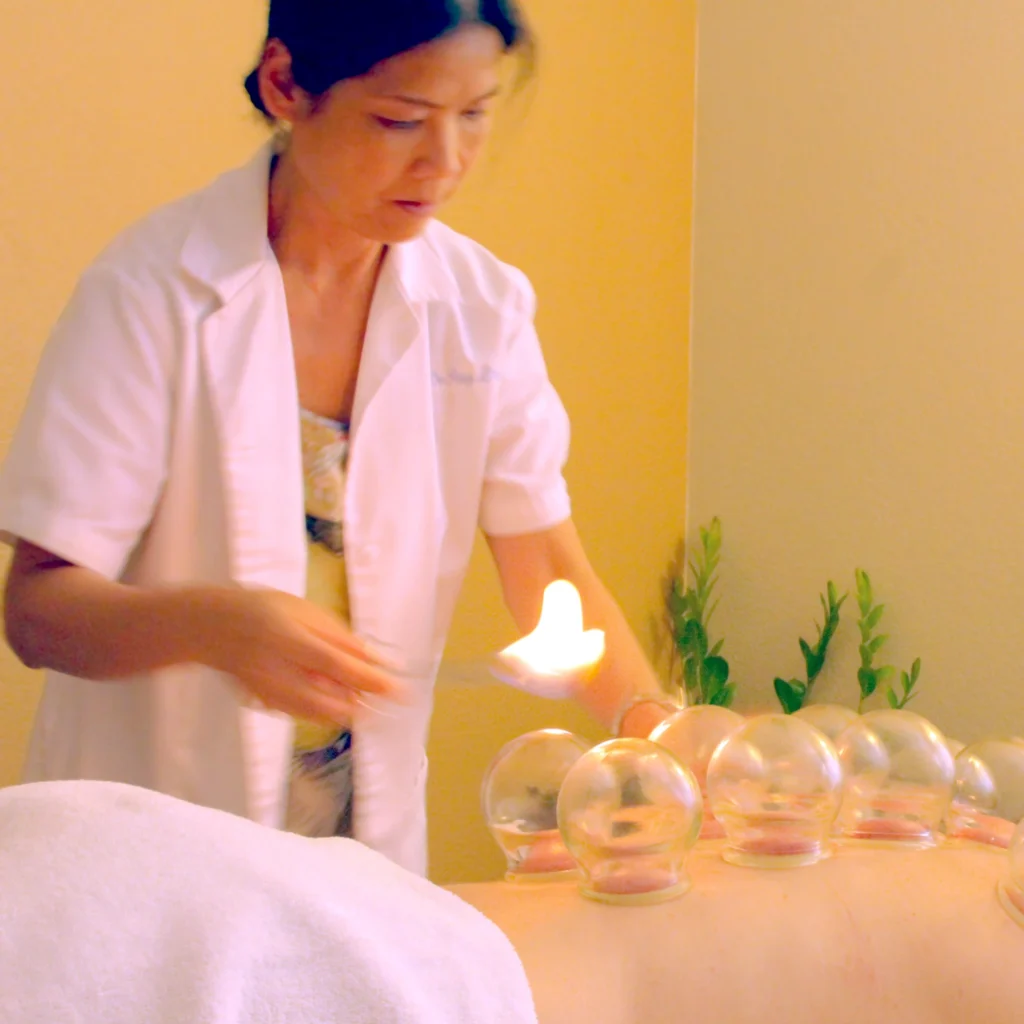
This is where full-length spinal cupping therapy, administered from T1 down to S5, creates an immediate therapeutic shift. By placing medical-grade suction cups along the Du Mai (Governing Vessel) and the bilateral Bladder Meridians, we introduce a powerful, localized negative-pressure vacuum.
While conventional massage therapy relies on downward compressive force, cupping works through upward tissue distraction and decompression. This negative pressure delivers three distinct physiological actions that directly target the spinal microenvironment:
- Vascular Recruitment and Inflammatory Shunting: The vacuum force instantly dilates deep and superficial capillaries, profoundly increasing local blood flow and skin temperature. This intense microvascular expansion forces stagnant, trapped inflammatory exudates out of the deep spinal tissues and into the superficial lymphatic system, where they can be systematically drained. By “pulling” the swelling away from the spinal column, we immediately reduce the hydrostatic pressure strangling the compromised nerve roots.
- The CSF Bio-Pump Effect: The continuous mechanical pulling of the myofascial layers creates a profound pressure gradient across the lumbosacral fascial planes. This mechanical distraction changes the intra-abdominal and paraspinal tissue pressure, acting as an external fluid pump. This kinetic change directly accelerates the velocity and turnover of cerebrospinal fluid within the sacral canal, delivering vital healing nutrients to stunned nerves while actively flushing out the inflammatory cytokines causing neural blockages.
- Amplifying Nerve Transmission Velocity: Walking cupping (sliding the vacuum cups continuously from T1 to S5) stimulates billions of high-threshold mechanoreceptors and A-beta sensory fibers in the skin. This massive torrent of somatosensory feedback travels at high velocity directly into the dorsal horn of the spinal cord. According to the Gate Control Theory of neurology, this intense afferent signaling effectively overrides local pain loops and sends a powerful “wake-up call” to dormant interneurons, restoring proper nerve transmission pathways from the brain to the pelvic organs.
Clinical Translation: Reversing "Permanent" Damage
The profound impact of this neuro-modulatory framework was recently demonstrated in our clinic. An elderly patient sustained a severe coccyx fracture from a traumatic fall, subsequently developing complete urinary retention within 48 hours due to the rapid accumulation of local tissue edema and pharmacological blunting from heavy hospital analgesics. Neurological prognoses suggested permanent dependency on a urinary leg bag due to suspected sacral nerve destruction.
However, our clinical assessment revealed that because the patient could void immediately after the fall, the nerve fibers were not severed; they were simply suffocated by post-traumatic neuropraxia.
Our treatment protocol target was clear: reboot the central nervous system using the Xingnao Kaiqiao acupuncture method, while simultaneously deploying a full spinal cupping array from T1 to S5. The cupping therapy functioned as the physical engine to clear the canal, rapidly evacuating the deep inflammatory fluid, boosting spinal fluid circulation, and restoring the nerve transmission velocity of the S2–S4 nerve roots. Within an accelerated timeframe, the patient’s dormant detrusor reflex was fully re-activated, resulting in a complete restoration of spontaneous voluntary urination. The patient bypassed the need for permanent catheterization entirely.
Post-Oncological Care and Systemic Immunity
This same dual-action mechanism provides crucial life-altering support for post-oncological patients recovering from the exhausting side effects of chemotherapy and radiation. Cancer therapies introduce profound systemic toxicity, often damaging the autonomic nervous system, causing severe bone marrow suppression, and leaving patients in a state of intractable fatigue, nausea, and neuropathic pain.
Because the back-Shu points along the spine directly overlay the visceral sympathetic ganglia, our paraspinal cupping protocol acts as a direct regulatory dial for the autonomic nervous system. The negative-pressure field shunts accumulated chemical toxins out of the deep myofascial layers and into the lymphatic circulation for rapid elimination, while simultaneously stimulating the hematopoietic (blood-building) microenvironment of the spine. This resets the patient’s systemic immune baseline, relieves post-chemo nausea, and dramatically accelerates the recovery of baseline vital energy.
Overcoming Structural Collapse: Reversing Degeneration in the Eighth Decade
The benefits of full-length paraspinal cupping extend deeply into structural and mechanical rehabilitation for elderly patients. As the human body reaches its seventh and eighth decades, the intervertebral discs naturally dehydrate, leading to chronic disc thinning, bone-on-bone friction, and severe spinal compression. This physical collapse forces the elderly into a state of structural kyphosis (stooping), severely restricting mobility and compromising internal organ function.
When we apply large-scale paraspinal cupping and sliding cupping from T1 down to the coccyx, we are applying a powerful upwards tensile force that introduces immediate physical decompression. This vacuum effect delivers a massive surge of local nitric oxide, inducing intense hyperemia (increased blood supply) that floods the paraspinal muscles and avascular intervertebral discs with oxygenated blood, growth factors, and healing nutrients.
Furthermore, this mechanical force intensely stimulates deep cutaneous mechanoreceptors and A-beta sensory nerve fibers. This high-velocity sensory feedback ascends the spinal cord, restoring proper motor nerve transmission and resetting muscle memory.
We have watched this structural transformation unfold in patients like Ray, an 80+ year-old gentleman who had suffered from chronic age-related spinal collapse. Through sustained spinal cupping therapy, the deep micro-circulation around his vertebral joints was successfully restored, allowing the worn intervertebral spaces to undergo biological rehydration and decompression. Not only did his severe chronic back pain vanish, but his entire posture visibly straightened, allowing him to stand taller and functionally “grow”in height reversing decades of degenerative structural decay.
A New Paradigm for Neurological Rehabilitation
At Eastern Medicine Center, we believe that true clinical excellence is achieved when we stop treating the symptoms and start optimizing the cellular and neurological environment. Spinal cupping therapy is not merely an ancient remedy; it is a sophisticated, biophysical technique that directly interacts with the body’s most advanced fluid dynamics – the Glymphatic system and the CSF-immune axis.
By understanding the anatomical pathways of the spinal cord and utilizing targeted vacuum decompression to boost circulation and nerve velocity, we are able to awaken dormant nerves, eliminate deep-seated inflammation, and significantly shorten recovery times for patients who have been told their functional loss is permanent.
By refusing to treat the spine as merely a column of bone and muscle and instead interfacing with it as a dynamic neurological highway and fluid gateway, we are rewriting the timelines of recovery. True healing is achieved when we look beyond localized symptoms and deploy a comprehensive, scientific framework that restores the body’s innate power to heal itself.
Whether recovering from central neurological trauma, severe sports accidents, post-surgical flaccidity, or post-stroke complications, the integrated therapies at Eastern Medicine Center provide the bridge from neurological shock back to vibrant, autonomous health.